
Families pass on not only memories, but also their secrets, omissions, and wounds. In the exhibition "Éramos silencios," Clotilde Jiménez retraces her Puerto Rican history, while the orange becomes the ambivalent symbol of this intimate memory.
Some silences ultimately speak louder than words. They transcend generations, seep into memories, and shape identities without ever being explicitly named. Clotilde Jiménez grapples with this invisible essence in "Éramos silencios" (We Were Silences), presented from September 16 to October 31, 2026, at the Mariane Ibrahim Gallery in Chicago. For her fifth exhibition with the gallery and her second solo show in the city, the artist turns to Puerto Rico: a land of origin, but also an emotional territory where memories, secrets, and inherited stories intertwine. The exhibition focuses more specifically on family histories and the inherited silences that have shaped her understanding of family and identity.
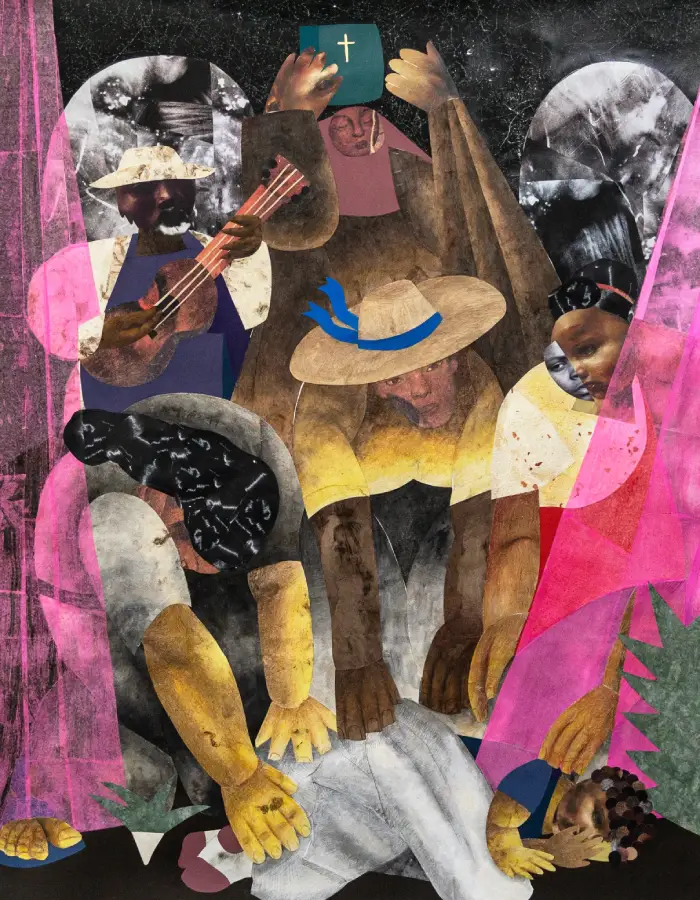
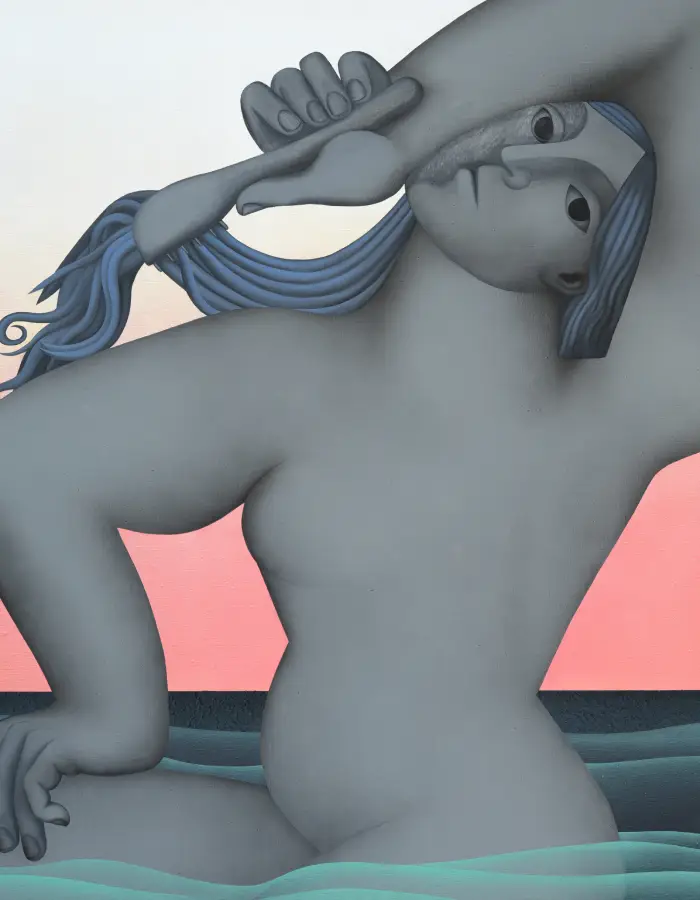
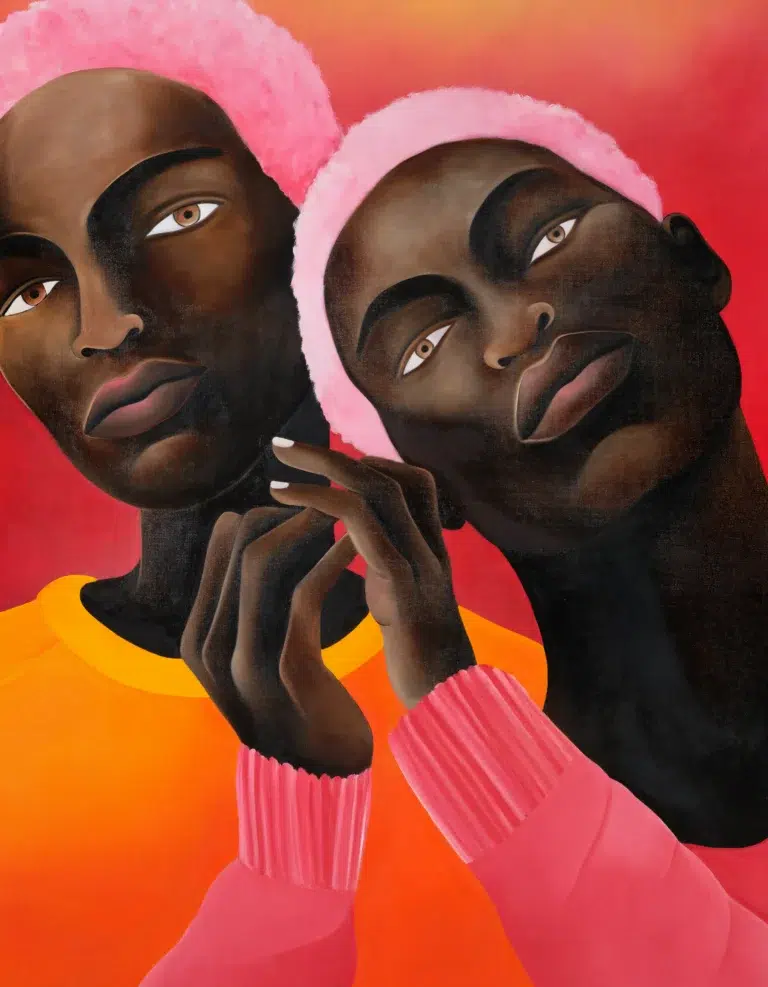
Born in Honolulu in 1990 and based in Mexico City, Clotilde Jiménez has for several years drawn on her own experience to inform her work. Her pieces explore how bodies and identities are constructed at the intersection of race, gender, and sexuality. “Éramos silencios” extends this reflection by exploring the theme of family transmission. Painting, drawing, collage, ceramics, and sculpture interact in compositions made of fragments and superimposed materials. Wallpaper, clothing, magazine clippings, and Mexican handmade paper form a composite vocabulary, reflecting a memory in which eras and experiences are constantly intertwined.
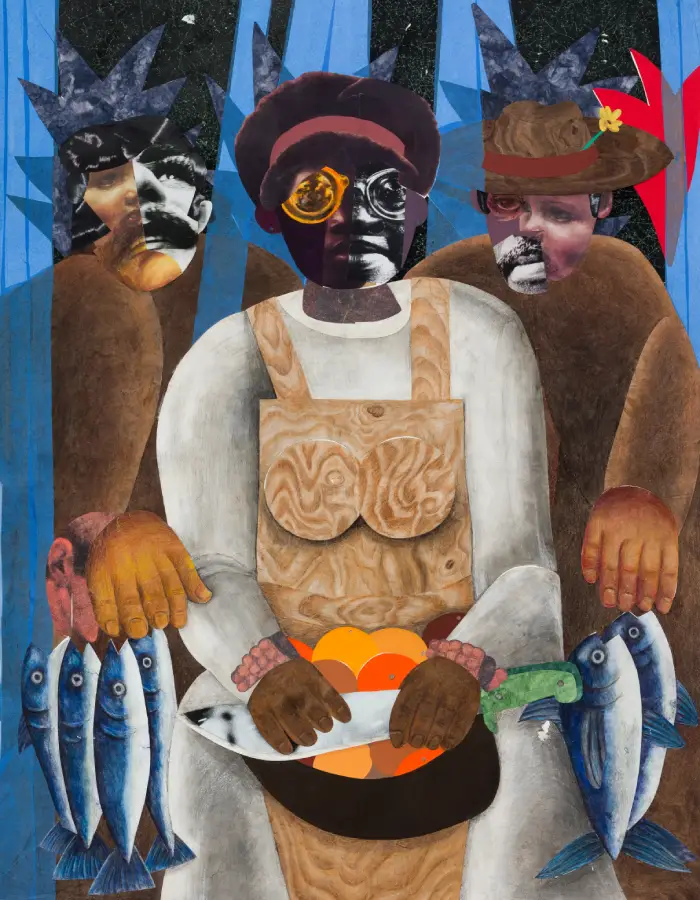
Amidst these narratives, a simple yet richly connoted form recurs: the orange. In Jiménez's work, it gradually becomes a veritable visual language with multiple meanings. Its roundness and radiance evoke sweetness, abundance, and fertility. But the fruit also carries within it its own shadow: beneath its luminous peel may lie spoilage, bitterness, or rot. The orange thus becomes the image of a family memory that nourishes as much as it conceals, that transmits as much as it leaves areas of shadow, as if metaphorically peeled back to reveal the traces of a history long kept secret. The artist makes it the image of a lineage that is both nurturing and imperfect, bequeathing its strengths as well as its wounds. The beauty of the fruit does not erase what silently decomposes, but offers it an even more unsettling covering.
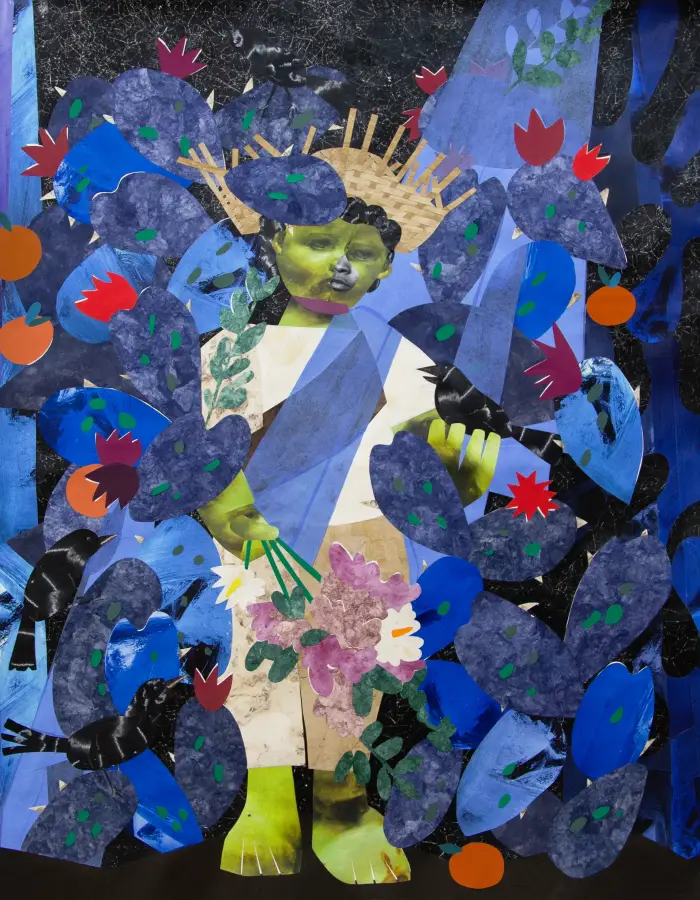
This ambiguity is particularly evident in the work China de Mayagüez (2026). The title situates the motif within a specific geography: in Puerto Rico, the word "china" refers to an orange, while Mayagüez is a city located on the island's west coast. In this composition, lush vegetation envelops two bent figures, busy filling a bag bearing the city's name. Leaves, flowers, butterflies, and fruit compose a scene of great chromatic intensity. Yet, behind this profusion, a sense of unease persists. The fragmented bodies and partially concealed faces seem to belong to a story whose pieces cannot all be brought together. The collage does not repair the ruptures: it gives them a presence.
The cutting and layering thus transcend mere formal processes. They express an identity made of fragments, sometimes contradictory versions, and archives both personal and collective. References to ancient, modern, and contemporary art mingle with ordinary materials, without hierarchy between scholarly culture and lived experience. The forms appear simple, yet each retains the weight of multiple histories. Nothing is entirely fixed: silhouettes meet, overlap, or seem to elude the viewer.
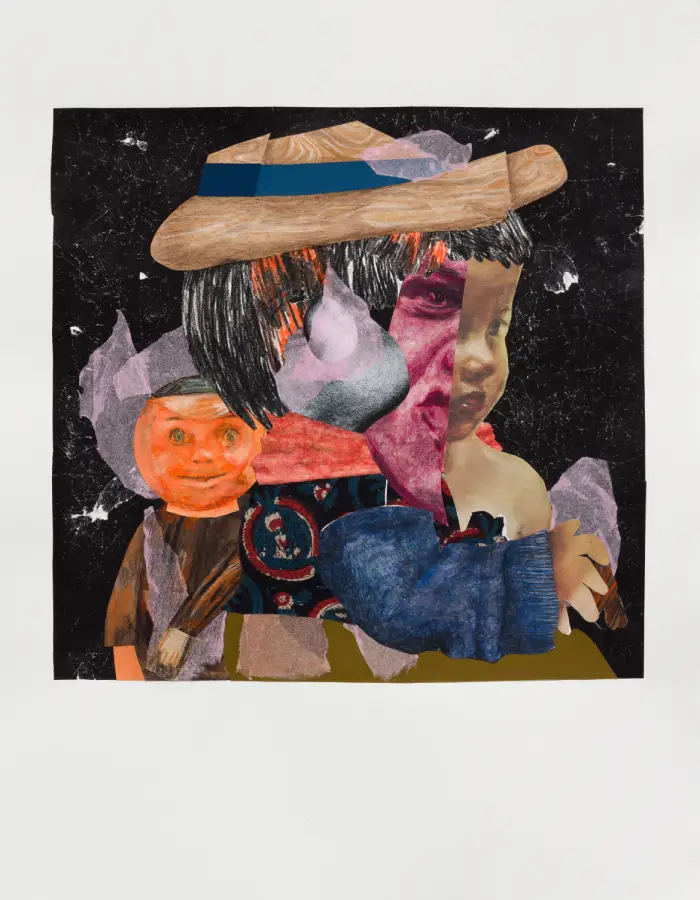
The exhibition's title, which could be translated as "We Were Silences," shifts the focus from an intimate narrative to a collective experience. Silence is no longer that of a single individual, but becomes a family language, a shared heritage. In revisiting his Puerto Rican roots, Jiménez does not seek to reconstruct a perfectly ordered genealogy. Rather, he lingers on the places where memory falters, distorts, or breaks down. These absences do not create a void around the work; they are its living heart.
Accompanied by an introductory text by curator Marina Reyes-Franco, “Éramos silencios” marks a moment of introspection in Clotilde Jiménez’s practice. The vibrant colors do not erase the shadows; they make them more palpable. Between gentleness and alteration, abundance and loss, the artist gives form to the unspoken and reminds us that every family history is also composed of what could never be told.
“Clotilde Jiménez – Eramos Silencios”
Mariane Ibrahim
437 N. Paulina St., Chicago (United States)
From 16 September to 31 October 2026