Torn, crumpled, sanded, ripped, stitched images… Fragments, relics, vestiges…
Intertwining the times of image production, from its destruction to its metamorphosis, and merging background and form in an astonishing process of metonymic contamination (the content becoming the container), Dune Varela's photographs create a perceptual disturbance.

Details of antique statues printed on marble, old photographs of temples printed on broken stones or mounted on aluminum plates and riddled with bullets… In these images of ruins in ruins, erased, pierced, torn… altered by the artist's gesture after having been altered by time, we do not know if their stigmata are from the past or the present, if they are in the image or on the image…
Apprehending the image itself as a vestige, as a ruin, the photographer seems to want to appropriate, to mimic the process of time imprinting – since the dawn of time – its scars on stone, from geological “sculptures” to ancient monuments subjected to erosion and destruction.

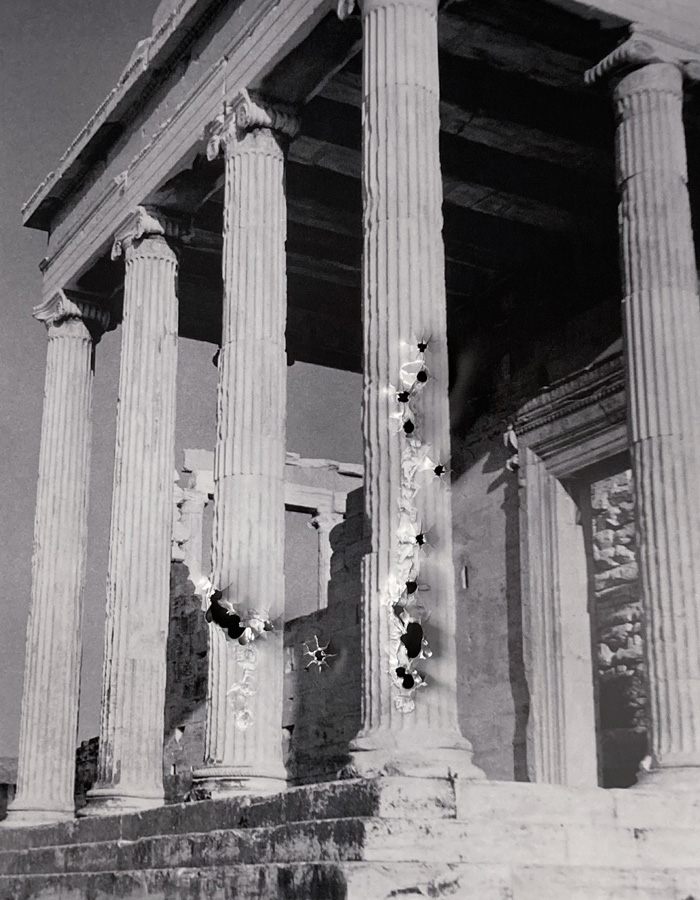
“Photographs of vestiges, vestiges of photography 1,” the images rely on a contamination of the photographed object (temples, ancient statues, and other ruins) by the medium, the matrix of the work, as if the represented object were incorporated into the image, into its representation. A mimicry that, far from being a purely aesthetic pursuit, can be strikingly truthful. For example, images of the Temple of Bel in Palmyra, before its destruction by the “Islamic State,” printed on broken stones… Or apartment blocks printed on concrete before being sanded in places. Or even a face replaced by a black halo on a refugee boat…
REMAINS
A mise en abyme of destruction, but also of time itself, the fragments of this archaeological imagery, like artifacts, false vestiges of an imaginary lapidary museum, are decoys. Printed on marble or ceramic, the photographs become sculptures; they are stone, they are plaster, they become matter… “To restore materiality to the image” is indeed the main objective of this work, which lies halfway between sculpture, archaeology, and photography (two 19th-century inventions). By printing fragments of screenshots onto pieces of ceramic or altered old prints onto glass plates, Dune Varela exhumes images that she then ingeniously superimposes like so many archaeological layers, leading us astray in the strata of time.
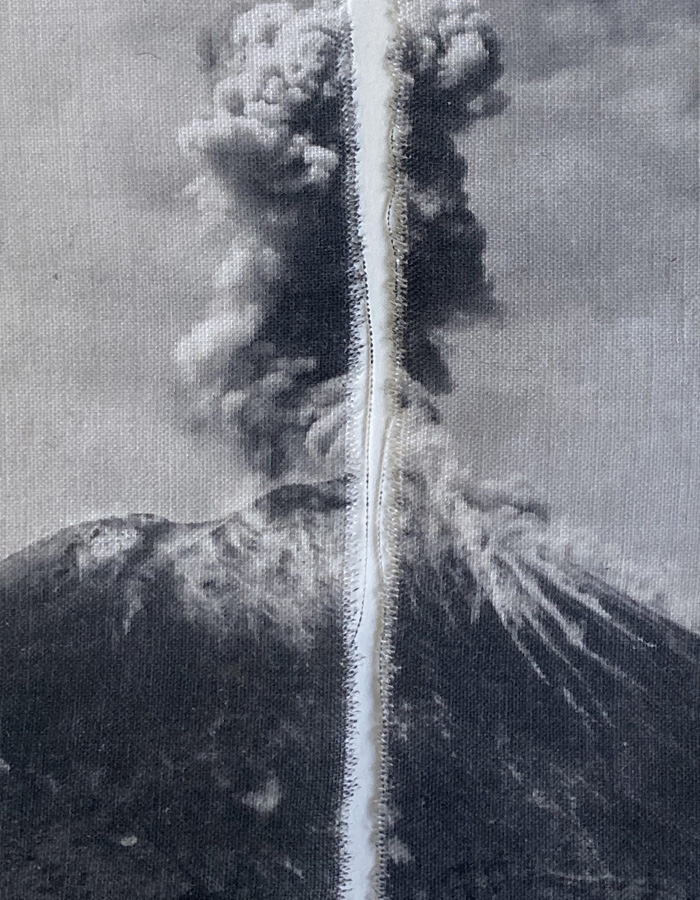
Torn seas and drifting icebergs stitched together, fires, explosions, and other scenes of cataclysm printed on linen weave, with great poetry, another narrative of time: that of repair. The stitched images speak of all our fragilities.
1 Michel Poivert, Counterculture in Contemporary Photography, Textuel Publishing
@POUSH
DUNEVARELA.COM