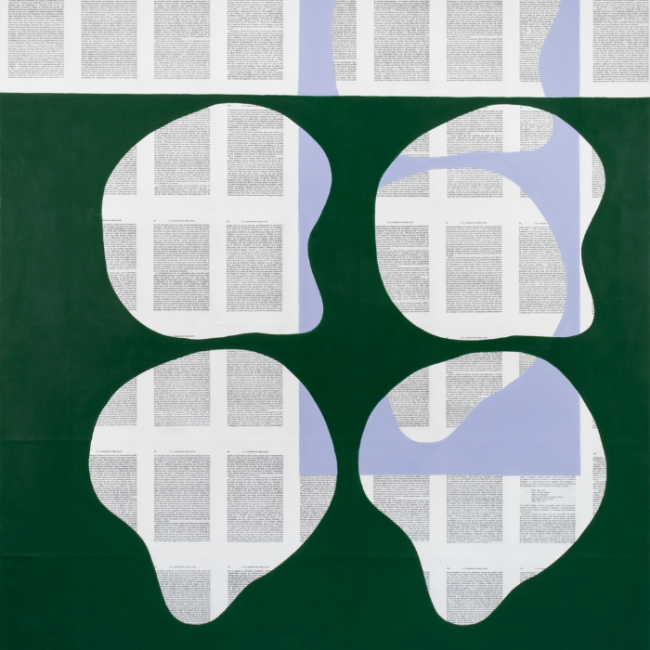
Photographic print (2023) from the eponymous performance that took place in 2000.
“Human beings no longer see themselves as the center, the decision-makers and measure of all things, imposing their will on an inert nature. The artwork emerges from a symphony that is both human and non-human.” It is in these terms that Guillaume Logé explains the concept of an emerging “symbiotic perspective” that, according to him, breaks with the linear, anthropocentric perspective inherited from the Renaissance. This concept is developed in a book and an exhibition bringing together some twenty artists working with living organisms, including Michel Blazy, Clément Borderie, Edith Dekyndt, Tomás Saraceno, and Yang Zhichao. It is the latter’s work, originating from a performance, that we have chosen to highlight. What could be more eloquent, indeed, than this vision of a back bristling with two blades of grass?
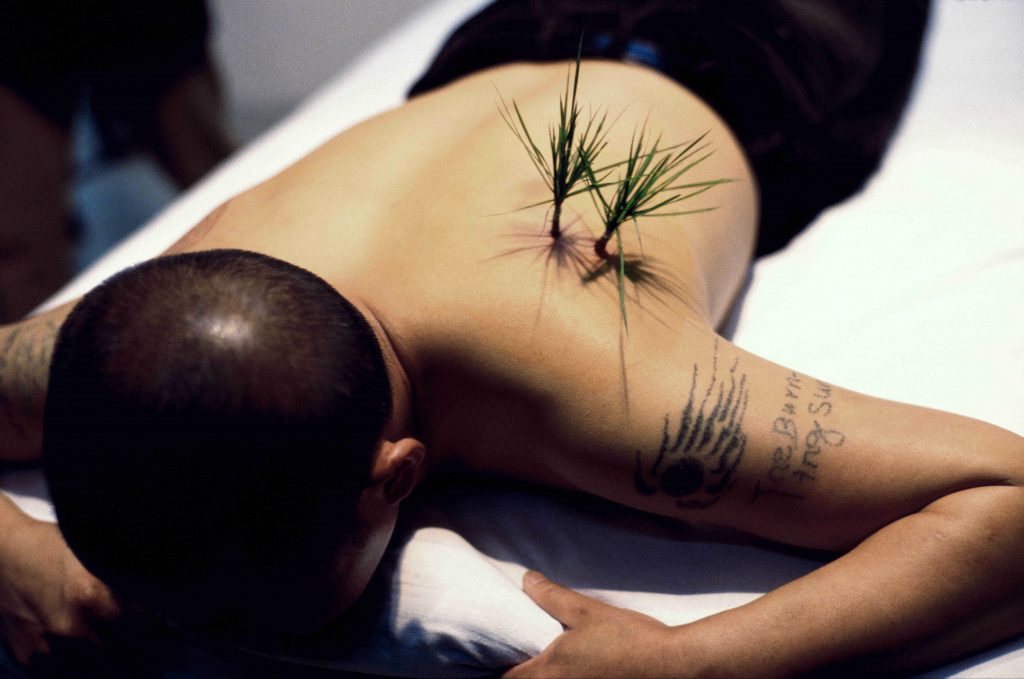
The artist's body, having undergone surgical grafting of the two cuttings, is visibly suffering here ("as one might assume the plant is") "and ultimately rejects the grafts," explains the exhibition's curator, emphasizing the work's significance in signifying the impossibility of hybridization based on "the goodwill of an all-powerful human" and the dead end represented by such an ecological vision: "Living things are not malleable at will." The dream of symbiosis here turns into a nightmare… Mutating an illusory biopower, Yang Zhichao invites us to integrity and warns us against the temptation of an overly artificial transgression of the animal/plant kingdoms.
- Wild Renaissance: The Art of the AnthropocenePUF, 2019
"Wild Renaissance: The Symbiotic Perspective"
Jousse Company Gallery
6, rue Saint-Claude, Paris 3rd
Until January 13, 2024