
On Saadiyat Island in Abu Dhabi, cranes are busy around Dar al Funoon, "the House of Arts." Announced at the end of June and now under construction, this performing arts center is one of the last works of Frank Gehry, who passed away in December 2025. Completion is scheduled for 2030.
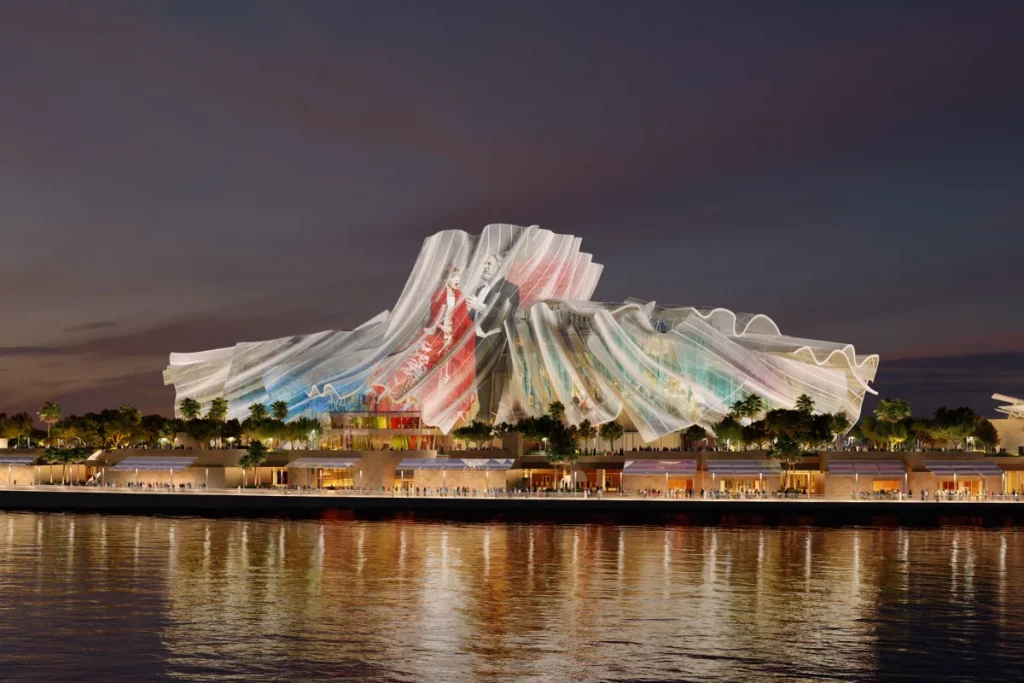
The gesture was thought to be over. Frank Gehry died in December 2025, at the age of 96; and now, in Abu Dhabi, one of his last built designs is rising. On Saadiyat Island, construction has begun on Dar al Funoon – “the House of Arts” –. Images show a pleated mass, a fabric of stone and metal that seems to glide across the ground, as if held for a moment before falling again. The façade, transparent in places, hints at the effervescence within. Nothing new in this vocabulary, some might say; yet everything about it still breathes invention. To deliver a Gehry today is to complete a sentence whose author placed the period elsewhere.
The building is not a single object, but a constellation of spaces. A large performance hall with over 2,000 seats, featuring an orchestra pit for 120 musicians; an open-air amphitheater with 3,500 seats for large gatherings; a 400-seat studio-theater designed for experimental creation; and finally, a 250-seat venue dedicated to jazz. This provides a total capacity of over 6,000 seats, in formats ranging from the most intimate to the most monumental. In addition, there is a rooftop terrace, restaurants, and retail spaces. The commissioning body, the Department of Culture and Tourism, promises 365 days a year of programming, artist residencies, and international co-productions.
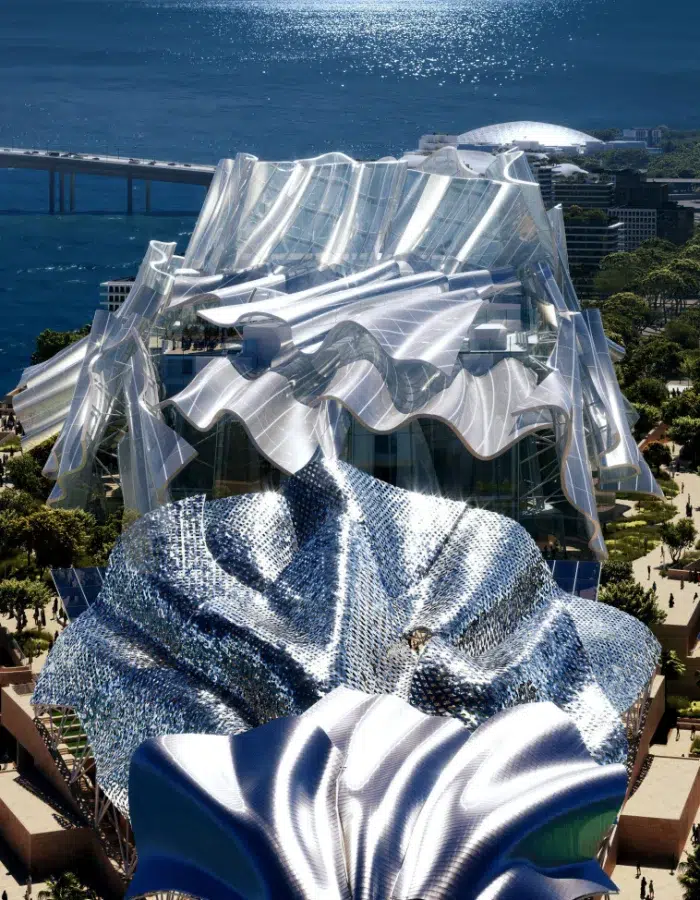
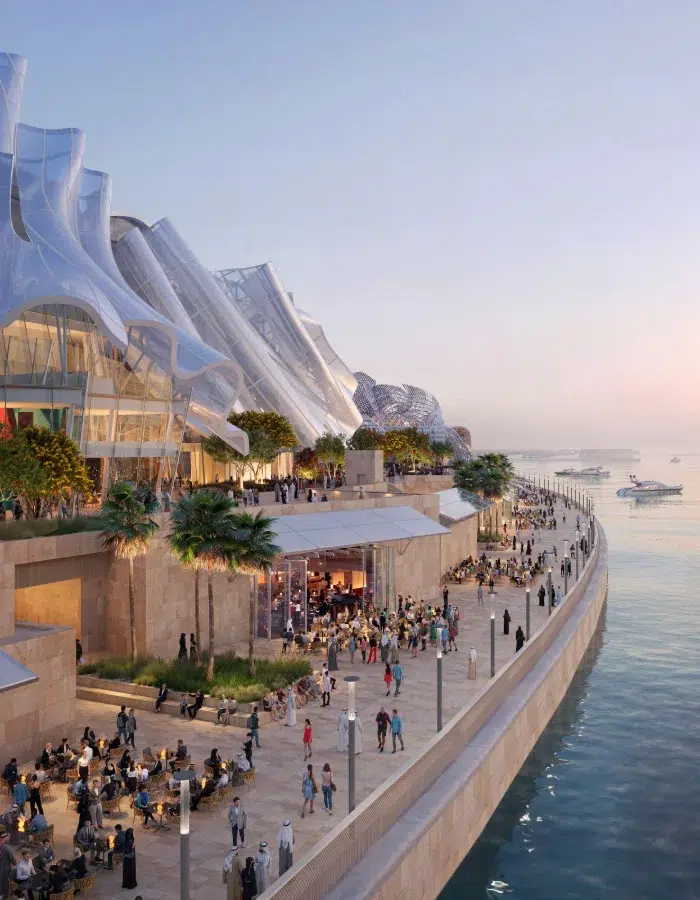
Dar al Funoon didn't appear out of thin air. Saadiyat Island has transformed into an archipelago of renowned museums: Jean Nouvel's Louvre, Foster + Partners' Zayed National Museum, Mecanoo's Natural History Museum, and, of course, the Guggenheim designed by Gehry himself. To this collection of international icons, the emirate adds a musical ambition: Abu Dhabi has been listed as a UNESCO Creative City in the music category since 2021. For the past twenty years, the emirate has been attracting the biggest names in the arts with the aim of transforming this sandbar into a cultural capital. The venue will be "a permanent home for live performance at the highest international level," summarizes Mohamed Khalifa Al Mubarak, Chairman of the Department of Culture and Tourism.
The question that haunts every posthumous work remains: what does one sign when the architect is no longer there to oversee the construction? Gehry made the crumpled form his signature, from the Guggenheim in Bilbao (1997) to the Walt Disney Concert Hall in Los Angeles (2003). His unbalanced volumes and titanium curves redefined what a cultural building could say about a city. Dar al Funoon adopts this grammar, adapted this time to the harsh light of the Gulf. Conceived as an instrument, the complex promises first-rate acoustics and a modularity capable of accommodating everything from opera to the most minimalist performance.
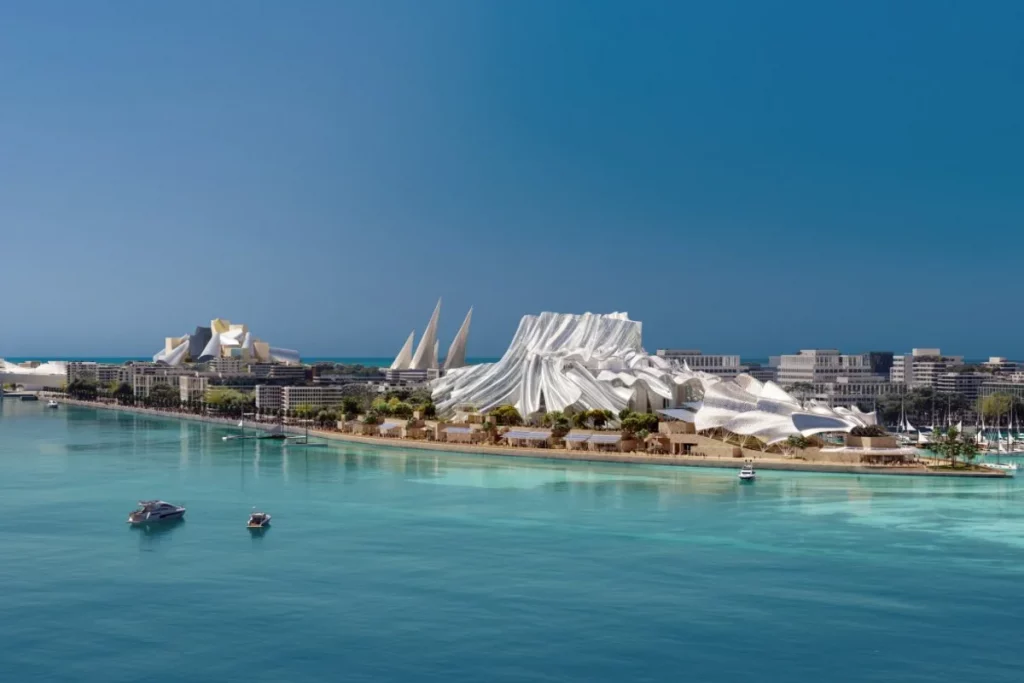
One might argue that the formula has become a trademark, that the "Bilbao effect" has turned into an export product beloved by the Gulf monarchies. One might also see in this final, pleated structure the coherent farewell of a man who spent his life giving the rigid an appearance of fluidity. The paradox is striking: one of the last buildings by a Los Angeles architect will rise facing the Persian Gulf, far from the cities that made him a king. A retrospective is paying tribute to him at the Serralves Foundation in Porto until December 30, 2026. In Abu Dhabi, it is the sand that will bear his mark.
Dar al Funoon Abu Dhabi
Saadiyat Island, Abu Dhabi (United Arab Emirates)
Architect: Gehry Partners
Opening planned for 2030