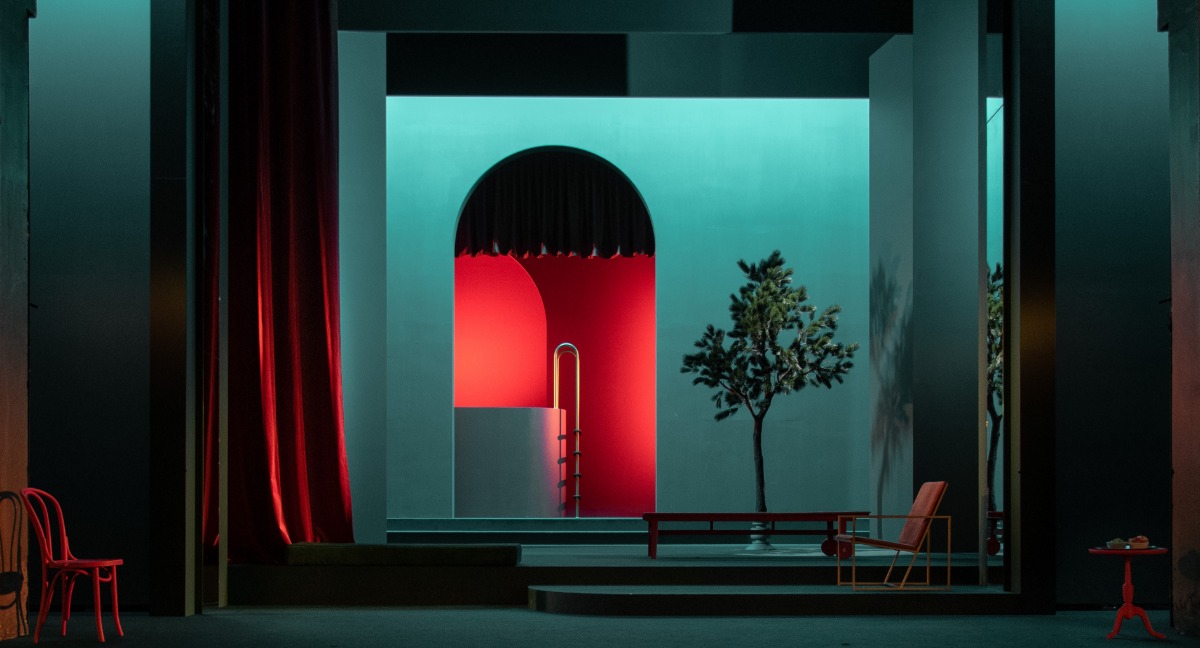
The inner courtyard of the Imperial Spa, formerly dedicated to the engine room of the historic building, has been transformed into a multifunctional acoustic and stage space, recipient of the 2024 Czech Architecture Prize.

The Imperial Spa of Karlovy Vary is a historical monument of international significance. The building bears witness to the golden age of European spa tourism and recalls the era when the Czech city was a center for the global elite. The technologies of the imperial baths are among the major inventions of the second half of the 19th century . Ferdinand Fellner and Hermann Helmer designed state-of-the-art mechanical installations.
“This is a unique mechanism for processing and distributing peat [plant material] , ” explains architect Petr Hájek, who led the project. “It was transported by a conveyor belt with an elevator from the treatment room, located outside the building, to the baths spread over several floors. This efficient system allowed us to serve 2,000 people in 100 thermal rooms per day, ensuring a rapid return on investment despite doubling the initial budget.”

Stage and acoustic technology
Today, the interior hall of the Imperial Spa, originally dedicated to technical equipment, has been redesigned to transform this remarkable building into a cultural institution. This project, costing nearly €60 million (1,5 billion Czech crowns), revitalizes both the heritage site and the cultural life of the Czech city.
The Karlovy Vary region, which has owned the building since 2019, commissioned Petr Hájek to design a multifunctional, multi-genre event space. The architect's portfolio includes the DOX+ Contemporary Art Center, the reconstruction of the terraces of the Lucerna Palace and the Letná Water Tower in Prague, and the design of the national pavilion at the 2016 Venice Biennale.
The 492-square-meter hall is equipped with state-of-the-art technology for concerts, theater, dance, conferences, film screenings, and popular music, functioning as a transformer. "The historic peat-making machine inspired our design ," the architect explains.


Modular installations
This modular space allows for modifications to the spatial and acoustic parameters to suit the needs of a specific production. The structure features a retractable stage, folding seats, suspension systems, and rails. The orchestra shell also incorporates a retractable screen that reflects the sound towards the audience.
A heavy curtain helps to dampen acoustic sound, while other elements allow for adjustment of the reverberation time (the prolongation of a sound), the direction, and the intensity of the sound energy. Rotating, three-sided acoustic panels, positioned above the stage, can also reflect, absorb, disperse, or direct sound.
The wooden planks, laid on the steel structure of the orchestra floor, play an equally important role, promoting sound circulation to better resonate with the musicians' instruments. "The hall can be compared to a Swiss Army knife ," adds Petr Hájek humorously.
The Karlovy Vary region is thus skillfully continuing the metamorphosis of this UNESCO-protected monument, which includes, among other things, a museum focused on the thermal industry.