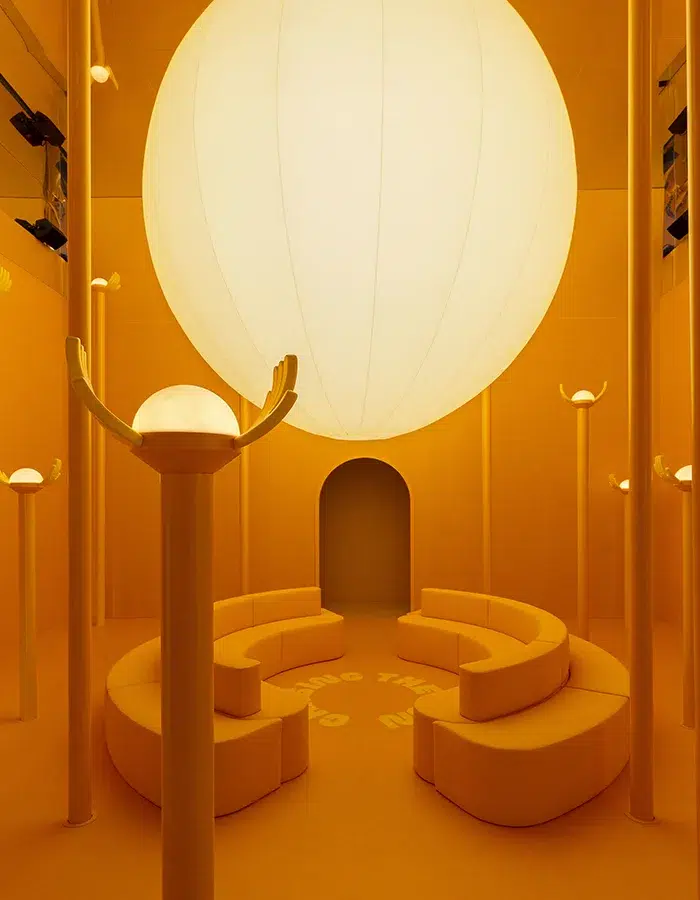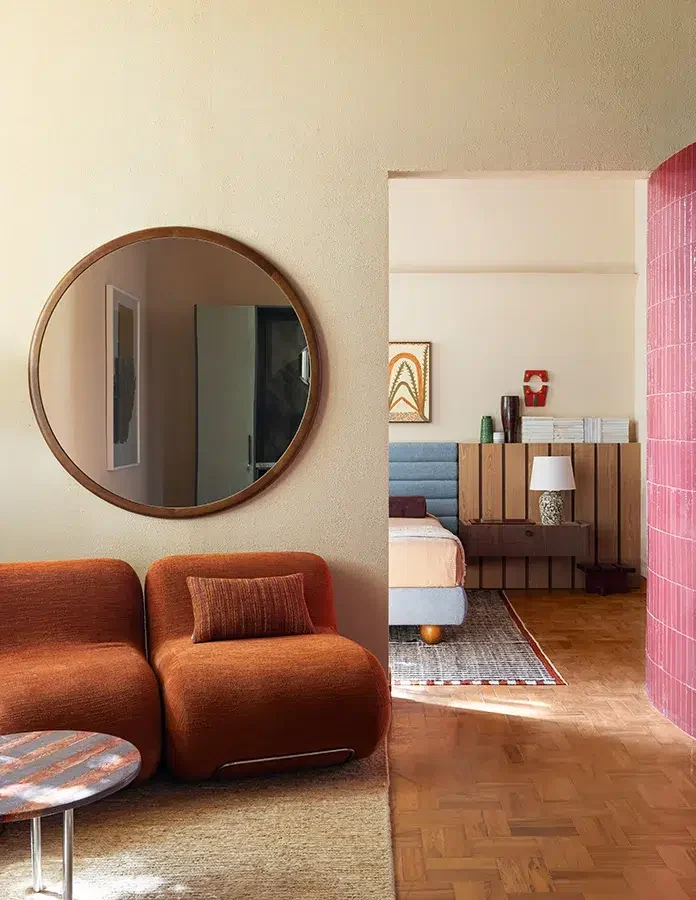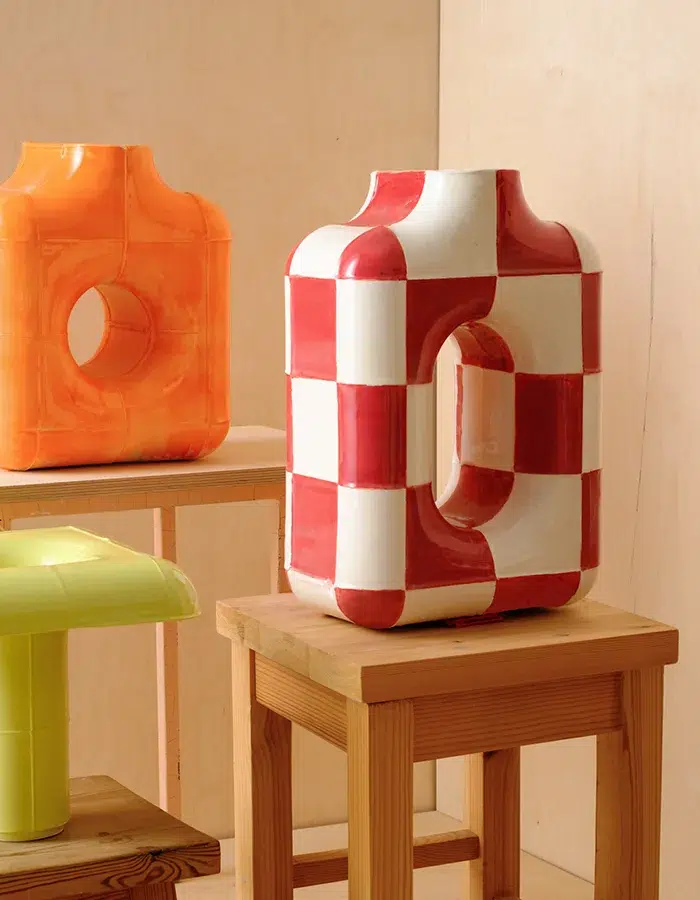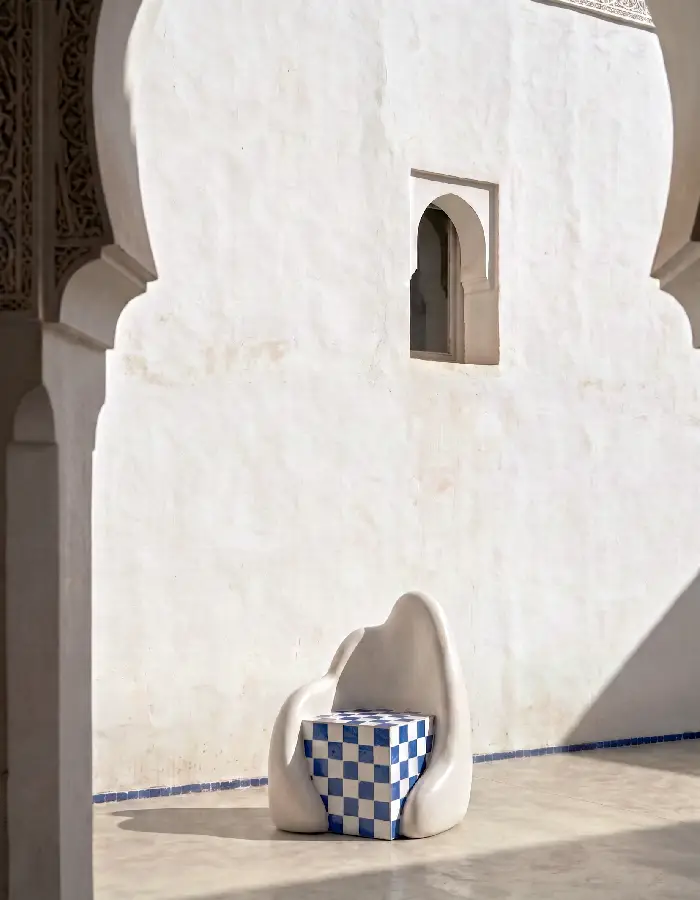


Some designers decorate spaces. Huma Sulaiman, however, infuses them with stories. In West Hollywood, her gallery Thús Huma reinvents South Asian craftsmanship in a warm, contemporary style, where each piece carries within it a memory of the world.


“Thús” is a Frisian word meaning “house.” Huma Sulaiman could have chosen any other name for her West Hollywood gallery. She chose this one because it perfectly captures her vision: here, it’s not simply about exhibiting artworks, but about creating a space conceived as a home, alive and inhabited by objects, materials, and emotions. Thús Huma is not just a gallery or a brand, but a way of inhabiting the world: a space situated at the intersection of art, design, and emotion, where each piece contributes to a larger narrative.
The daughter of diplomats with a passion for art and history, she grew up in a nomadic lifestyle that taught her early on that the beauty of a space lies as much in what it conveys as in what it shows. As a child, she lived within the very walls of the Bangladesh Parliament, designed by the architect Louis Kahn, a formative experience she still recalls with emotion. Later, after a career in IT, she and her husband moved to Bengaluru, where she discovered design. A friend visited her home, was captivated by what she found, and suggested she meet the director of the Taj Vivanta. And so it all began, not out of ambition, but out of a sense of inevitability.

In 2011, upon returning to Southern California, she founded Huma Sulaiman Design, a firm that has received the Luxe RED Award, the California Home + Design Award, the NKBA SoCal Award, and is listed in the Architectural Digest directory. Thús Huma, opening in late 2025, is the next step, a space designed not to show, but to evoke feeling.
Entering these spaces is like entering someone's home. The pieces aren't placed on pedestals; they live within habitable compositions, designed to be felt as much as looked at. Beauty, according to Huma Sulaiman, isn't seen: it's felt. In a design market often torn between icy minimalism and decorative excess, she charts a third path: that of contemporary warmth, a contemporary style that breathes. Her philosophy boils down to one idea: creating a dialogue between two worlds. Ancient craftsmanship and today's design, South Asian cultural heritage and contemporary Western sensibility. Not simply juxtaposing them, but merging them until the seams disappear. She speaks of "adorned living," an ornamental art of living where objects, materials, and forms construct spaces of resonance, places capable of carrying memory, emotion, and presence.


At the heart of his approach lies a simple yet demanding idea: to bring heritage to life, to give it a contemporary form without betraying it. The Foyer Table is the most striking example. Its tabletop, covered in shitol pati (“fresh mat”), hand-braided by master craftsman Haren Das of Sylhet, Bangladesh, effortlessly blends ancestral technique with modernity. This is not nostalgia, but a dialogue between two eras. The Jamdani fabric tells the same story differently: a descendant of Mughal muslin, once known as “woven air” and listed as UNESCO Intangible Cultural Heritage, it has been reinterpreted by Huma Sulaiman through precise geometric patterns, reflecting the rigor of form that permeates all his creativity. Luxury does not disappear; it simply shifts its register.

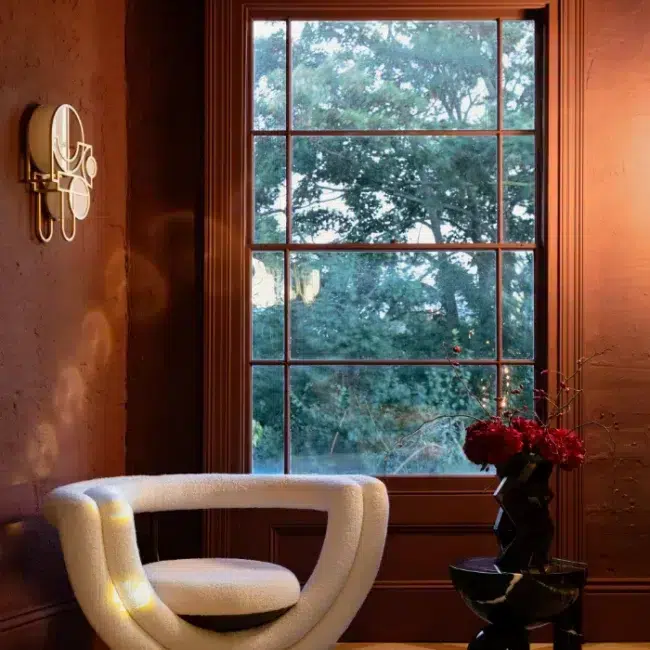
His own creations, made in Los Angeles, bear the same imprint. The Giza Chair in carved walnut, caning, and brass creates a silhouette whose continuous curves and inverted pyramid seat echo his cultural heritage without ever explicitly referencing it. The Zoya Table in patinated steel and oak exudes a tranquil presence, something between sculpture and furniture. The Reflektor Pendant, a chandelier infinitely modular in shape and finish, questions the boundary between lighting and installation. And then there is the Kubo, designed specifically for Thús Huma: a sculptural sofa in beige concrete with organic curves, the Kubo Sitting, paired with a central metal fireplace, the Kubo Fire Pit. A truly unique piece, born from the desire to create sculpted outdoor seating rarely seen, in a constant tension between the heaviness of the concrete and the lightness of the lines. A silent invitation to sit, to draw closer, to stay.


For Huma Sulaiman, the creative process often begins with a fleeting sensation: a light glimpsed during a trip, a shape observed on a beach during a morning run, an architectural detail capable of evoking immediate wonder. From this initial emotion, she slowly composes a language of textures, materials, and references, like a mental tapestry where each element adds a layer of depth.
The gallery also features other designers. Among them is French designer Nadège Mouyssinat, whose Pseudospheres—hand-shaped porcelain cones with unique mineral textures—occupy a prominent place, whether in the console version or the more intimate Little Sanctuary. In the coming months, Thús Huma will also welcome Colombian designer Mercedes Salazar, a multidisciplinary artist and jeweler whose work explores the boundaries between matter and spirituality.

Thús Huma reinvents itself through residencies, pop-ups, collaborative installations, and private salons. “Thús Huma is a long-held dream,” says Huma Sulaiman. “It’s an opportunity to showcase not only my own work, but also to champion that of other creators from around the world.” Having transformed her home into a gallery and her gallery into a home, she now envisions Thús Huma as an immersive and constantly evolving universe, a fluid refuge dedicated to art, design, culture, and lifestyle. Guided by the quiet conviction that the most beautiful interiors are those that tell a true story, she continues to create spaces that feel less like sets and more like sensory worlds.
Visit by appointment only.
www.thushuma.com
Instagram: @thus.huma
Thús Huma: By appointment only: info@thushuma.com