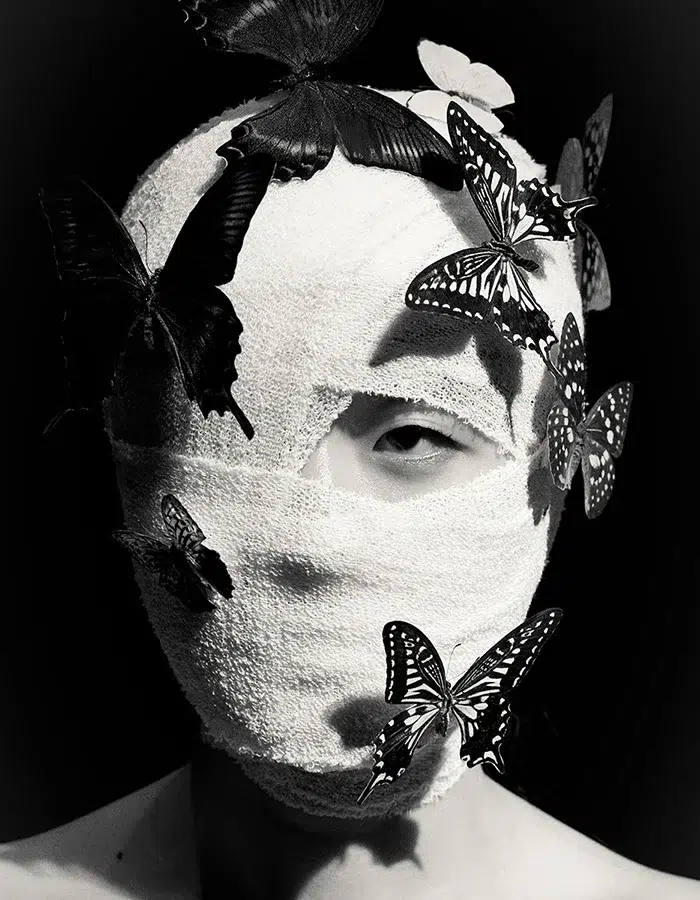
At the beginning of this year, the David Zwirner Gallery in London presented forty years of work by the German artist through his experimental approach to photography between abstraction, light and technology.

“There isn’t just one way to take photographs. There are thousands of possibilities to choose from… I’m simply interested in the result and whether it’s worth discussing.” For over forty years, Thomas Ruff has explored the photographic medium, encompassing portraiture, nudes, landscapes, and architecture, manipulating all available techniques. From “anachronistic devices to the most advanced computer simulators, and many areas in between.”
This graduate of the Düsseldorf State Academy of Fine Arts first gained recognition in the 1980s for his ongoing exploration of the "grammar of photography." From January to March, the David Zwirner Gallery showcased his talent as a dedicated experimenter in its London space. Spread across two floors, the exhibition juxtaposed his recent series with a selection of images that traced his career, demonstrating his ever-expanding approach to the medium.
Games of abstraction and light
On the ground floor, Thomas Ruff presented for the first time two bodies of work that are an extension of his research on photographic abstraction. With " Luminous Experiments ," the image is approached scientifically, representing pure light through an electromagnetic spectrum. In his studio, he placed glass objects (lenses, mirrors, prisms) on a white canvas, onto which he shone beams of light to capture reflections and refractions. By then digitally inverting the images, the composition creates this interplay of light between dynamic bands and lines. His works, printed on matte and velvety surfaces, thus appear as pictorial abstractions.
With untitled# , he focuses more on formal experimentation. Thomas Ruff captures the movement of a rotating silver coil against a black background, then digitally edits the images, applying a blue halo effect to the edges for a vintage touch. His wire constructions are similar, photographed to produce abstract and figurative images. As the gallery explains, he draws inspiration from Étienne Bertrand Weill's Metaforms , created in the late 1950s (long exposures recording the movement of motorized mobiles with glass, metal, and wood rods), and from Peter Keetman and Heinrich Heidersberger's Rythmograms of the 1950s and 1960s (complex light patterns that visualize time and movement).


From the past to the present
All these explored themes reappeared in the second part of the exhibition on the first floor, dedicated to his past works, such as dope. or negative , a previously unseen print from his groundbreaking Porträts series . The exhibition continued its examination of the relationship between past and present. For example, Fotogramme , created entirely in digital darkrooms, depicts abstract forms, lines, and spirals whose random formations adopt varying degrees of transparency and lighting. The same is true for Substrat , which, like his jpegs series , takes as its starting point Japanese comics and manga found online to further experiment with photography.
Thomas Ruff continues to question and re-examine the limits of photographic representation. This selection at the David Zwirner Gallery, spanning forty years of his career, illustrated his approach to the medium's potential, reminding us that photography was long considered an art form inferior to painting. Moreover, the exhibition highlighted his visual strategies and genre studies, exploring the interplay between analog and digital processes in an infinite manner.

"Thomas Ruff: luminous experiments"
David Zwirner Gallery
24 Grafton Street, London (England)